A creator went quiet after you asked for metrics. What should you request?
A promising creator conversation stalls at the data request. Narrow the ask to the next decision, accept useful existing material, and give a clear response timeline.


The conversation was going well. The creator was interested. Then you asked for audience data and recent results—and the replies stopped.
Before sending another reminder, make the request easier to answer. Explain the collaboration you are evaluating, the information you still need, an acceptable format, and when you will get back to them. Every item should help you make a specific decision. Silence alone does not tell you whether their numbers are unreliable.
A pet-brand founder described this problem in a Reddit discussion: some promising conversations stalled after they requested metrics for a paid partnership. In one case, hidden post like counts and Reel view counts made evaluation harder. The post establishes the problem, but does not establish why those creators stopped replying.
Start with what you are buying: content, distribution, or both
“Could you send your information?” leaves the creator guessing. Do you want a rate card, a portfolio, or screenshots from their analytics?
If you are commissioning a video for your brand to use, start with relevant work samples, production requirements, delivery timing, and usage scope. If the creator will also publish on their own account, audience fit and the performance of comparable content become directly relevant to that placement. If you need both, list production and posting separately.
Write down one sentence before requesting anything: “What decision will this information help us make?” For example: “Confirm whether the audience overlaps with our target market before discussing a fee.” If an item will not change that decision, leave it for a later stage.
The repetitive part is often checking what the creator has already sent. OneCrew is a tool for organizing creator records and outreach conversations. Add the campaign goal, information received, and remaining gaps to the creator's notes. Use those notes alongside recorded conversations to identify what you actually need to ask next.
Ask for a few useful items, not an entire presentation
A media kit is a creator's introduction to their account, audience, and partnership offering. A current, relevant one is useful. A creator who does not have one should not need to build a slide deck just to answer your first questions.
For an initial assessment of a product-review post on the creator's own account, you could organize the request around these three decisions. Adapt the list to the campaign.
1. Does the audience overlap with our market?
Request audience countries or regions for the relevant account. Ask for age or other characteristics only when they matter to the product. Explain the purpose: “This campaign targets [market], so we want to check audience fit.”
2. How does comparable content perform?
Start with links to recent posts in a similar format. Request screenshots only for relevant metrics you cannot assess publicly, and specify the context: “Please include the account, content, and reporting period.”
3. Can we arrange the collaboration?
Ask for the fee for the proposed format, included deliverables, and availability. Make the scope concrete: “We are considering [format] within [launch window].”
For a content-only commission, replace audience questions with relevant work samples and focus on creative fit and delivery requirements. Do not collect metrics simply because your spreadsheet has a column for them.
Numbers also need context. Account results over the last 30 days and results for a single post's first seven days answer different questions. Those time windows are examples, not prescribed standards. Agree on a useful basis for comparison, and ask for clarification when a screenshot does not show it.
Send a request the creator can answer directly
Share enough about your offer to make the request meaningful. Otherwise, the creator is being asked to compile information before knowing what the opportunity involves.
Use this template as a starting point. Replace the brackets, remove irrelevant items, and leave out information already provided.
Subject: [Brand] × [Creator]: a few details for the proposed partnership
Hi [Name],
Thanks for being open to a conversation.
We are exploring [content format and publishing account] around [product and use case], aimed at [market]. Our proposed launch window is [timing], and our budget position is [confirmed range, or an accurate explanation of the quote-review process].
To assess whether this is a fit, could you share:
① [Audience information relevant to this campaign].
② [Recent comparable content links and any essential additional metrics], with the account and reporting period visible.
③ [Your fee, included deliverables, and availability for this format].
An existing media kit or screenshots are fine—no new presentation needed. Feel free to redact unrelated personal or client information. If an item is not available, please let us know what you can share instead.
If we receive this by [date and time zone], we can respond with next steps by [date and time zone]. If that timing does not work, let us know what does.
Thanks, [Name]
Be accurate about budget. If it has not been approved, explain that you are gathering quotes and say when you expect to provide an update. Only promise a response date your team can meet.
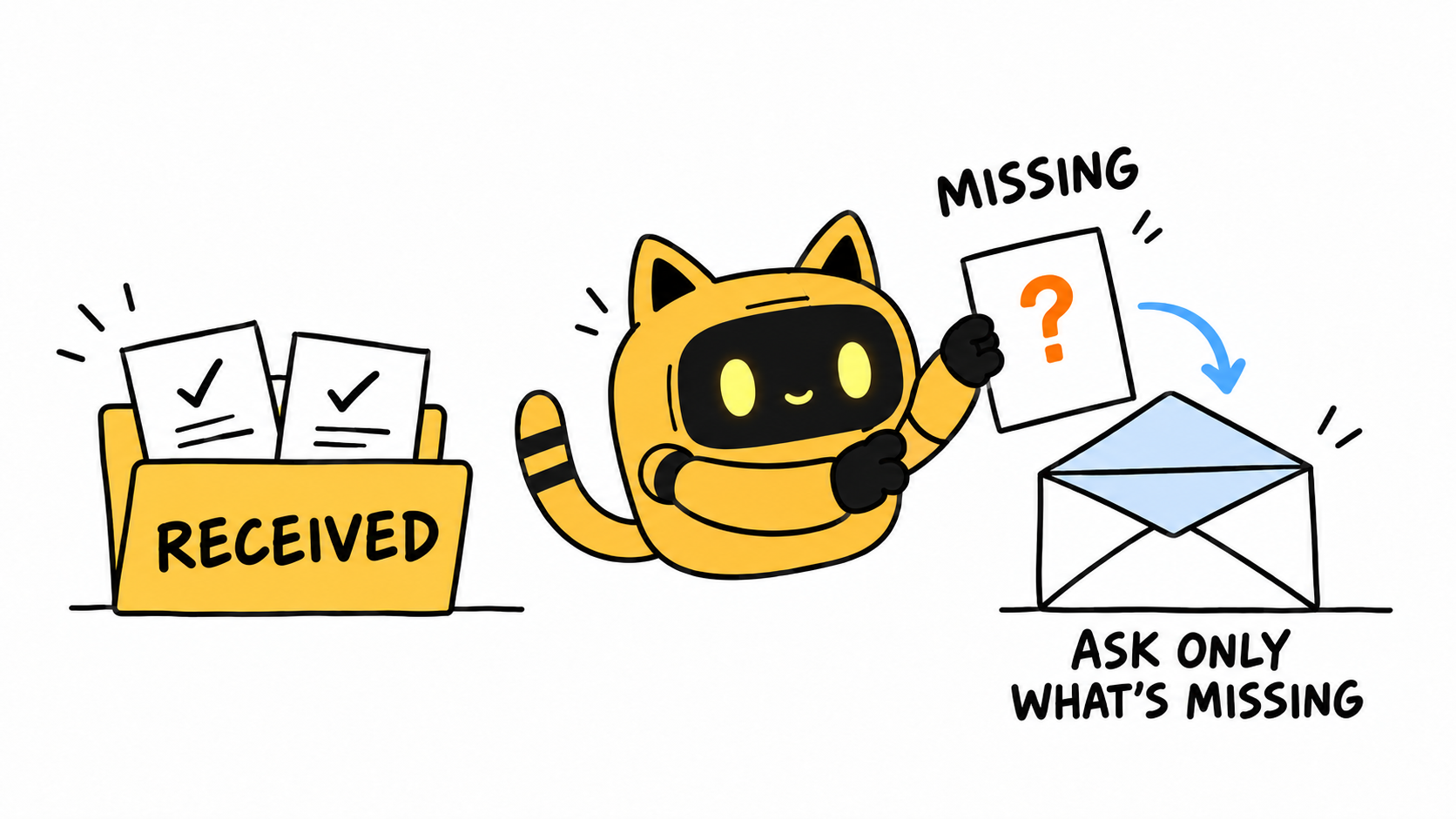
With OneCrew, you can ask AI to organize the creator's notes and recorded email exchange into information received, missing items, and points to clarify. Use that context to prepare and save an email draft. The owner checks the recipient, offer, purpose of each request, and dates before sending. The next email asks for the gaps instead of repeating the whole checklist.
When the information arrives, check whether it answers the question
Receiving a file is not the same as having enough evidence to proceed. Check four things before moving to fees or scheduling:
- Account: Is this the account you plan to work with?
- Period: When was the material prepared, and what period do the figures cover?
- Content: Are the examples comparable to your proposed format? Separate routine content, relevant product content, and an exceptional high-performing post.
- Remaining gaps: Would a missing item change your decision?
Do not enter a zero for a metric that is not shown, or replace unavailable data with a guess. A useful note is: “Audience regions received; recent comparable content performance still needs clarification.”
When you update the creator's notes in OneCrew, keep the date and the reason for your assessment. A colleague can then see the evidence and open questions, rather than an unexplained label such as “weak metrics.”
Once you have enough information to discuss the partnership, use the next-step checklist in what to send after a creator says “I'm interested” to clarify deliverables and the next action.
Still no reply? Decide based on what is missing
Before following up, check whether you can make the purpose clearer, shorten the list, or accept an easier format. “Just checking in” does not reduce the work required to answer.
- You already have enough information: Move forward. A fully populated spreadsheet is not the objective.
- One item is missing, with a useful alternative available: Ask whether an existing screenshot, relevant work sample, or other suitable material can answer the question, and agree on a reply date.
- An essential item is missing and the agreed date has passed: Pause this opportunity and record what would allow you to reconsider it.
If you need to close the loop, try:
We still need [essential information] to complete our assessment. For this campaign, we will move ahead with other confirmed arrangements. If you can share the information later and the timing works for both sides, we would be happy to revisit a future opportunity. Thanks for the conversation so far.
Pausing is a decision about the information available today, not a finding that the creator is unprofessional or has falsified their metrics. An existing signed partnership needs a separate review of the arrangements already agreed; do not apply an initial-outreach checklist to an active contract.
Make the next email specific
When a conversation stalls at the metrics request, narrow the ask to what supports the next decision. Explain the purpose, format, and response timing. Keep the essential questions, and stop asking for material you already have.
Start with one creator record in OneCrew. Note what you have received and what is still missing, then prepare an email draft that asks only for those gaps. That gives the next fee discussion, scheduling decision, or handoff a clear basis.