Commission-only creator outreach getting ignored? Make the offer clear
Explain why you chose the creator, how commission works and what you need from them. Use a terms checklist and three adaptable outreach email templates.

Your invitation promises a generous commission and a long-term partnership. The creator may see something less appealing: production work upfront, with no clear idea of what they would earn or how payment would work.
An effective offer explains who it suits, how earnings are calculated and what the creator would do. Start with the information someone needs to evaluate your proposal, rather than treating a particular percentage as the answer.
Choose creators who have a reason to consider the product
Look at recurring topics, the situations their audience cares about and how the product could fit. A creator who compares commuter bags might have a reason to discuss a useful laptop compartment. A large following alone gives you little to say in an invitation.
Retain one specific piece of evidence for each candidate: a content link, the need it addresses and a verified product detail that connects to it.
OneCrew is an AI workspace for creator discovery, lead organization and outreach. Add checked content links, matching reasons and open questions to the notes for a saved creator. Your connected AI can use those details and recorded conversations to prepare an invitation; check the content reference before sending. A teammate who picks up the conversation can then see why you chose that creator.
Explain the commission as a set of terms
A percentage needs a calculation basis. Confirm which order value qualifies, what happens to refunds, when payment is made, how it is sent and which records the creator can review. Resolve missing terms with the appropriate person before presenting the offer.
For a hypothetical order with US$100 in eligible value and a 10% commission, the commission is US$10. This illustrates the calculation; it does not forecast sales or earnings. Actual payment follows the agreed order eligibility and settlement records.
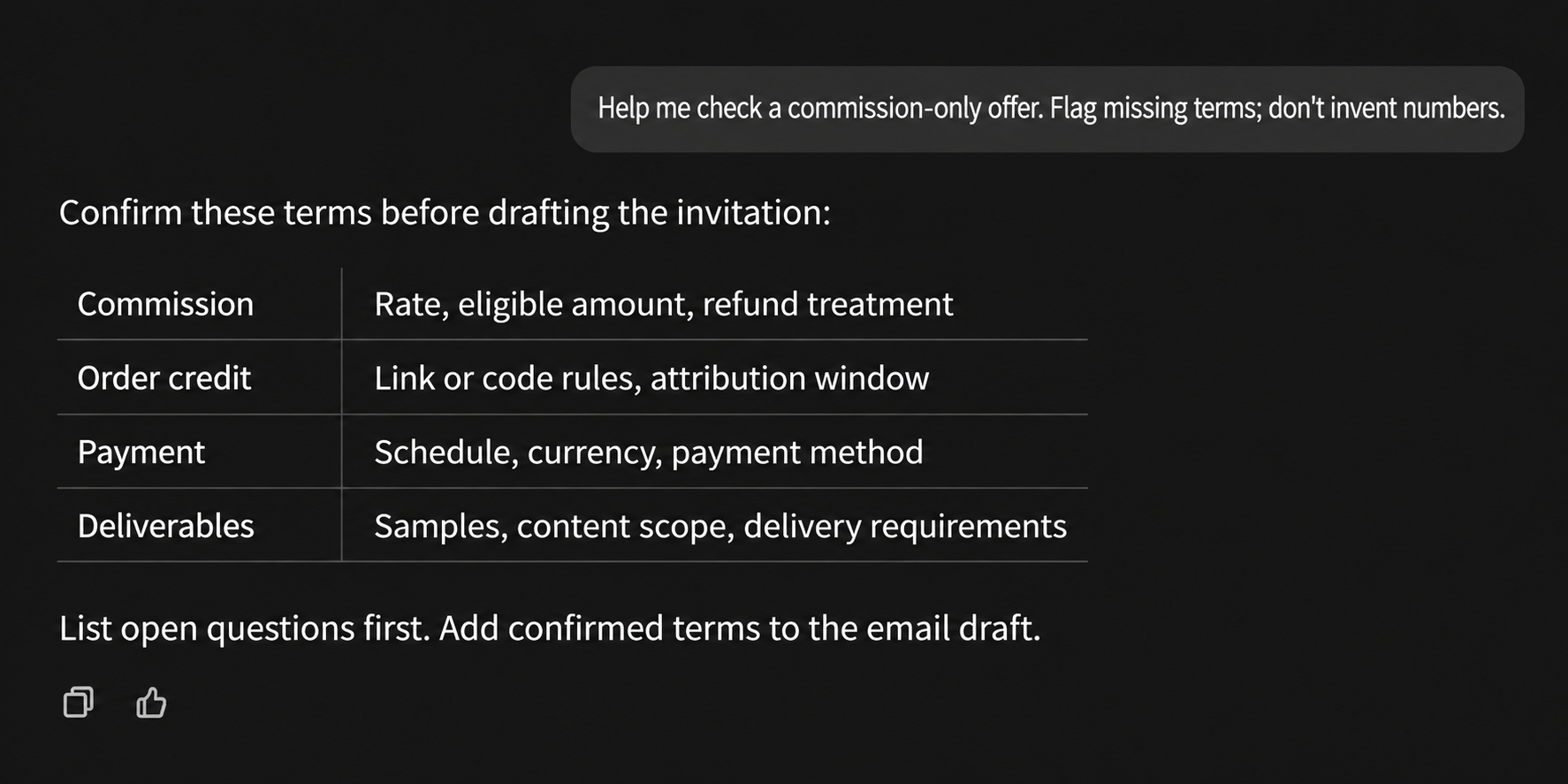
Use the relevant conversation in OneCrew and provide the confirmed terms to your connected AI. Ask it to draft the explanation and list missing information as questions. Review the output so an assumption in a draft does not become an accidental promise.
Confirm how an order is credited to the creator, too. An attribution window is the period after a qualifying referral during which a purchase may count toward that referral. Code-based credit and competing referral sources also need clear rules from the program you actually use. Give your connected AI the confirmed policy in OneCrew alongside the commission, refund and payment terms. Review the resulting explanation before sending it, so both sides can refer to the same terms when an order is disputed.
| Confirm before sending | What the creator needs |
|---|---|
| Compensation model | Commission-only or any additional fixed fee |
| Commission | Rate, eligible value, orders and refund handling |
| Order credit | Link or code rules, attribution window and competing referrals |
| Payment | Schedule, currency, method and reviewable records |
| Samples | Whether one is provided, shipping costs and return arrangements |
| Deliverables | Formats, quantity, timing, revisions and requested usage |
Sending a sample does not mean a creator has agreed to publish. Distinguish an invitation to try the product and discuss a partnership from agreed content deliverables. Confirm shipping costs and any return arrangements. If you want a set number of videos, revisions or additional use of the material, include those requests so the creator can assess the full workload.
Before drafting, ask AI to check the confirmed terms against these four categories. Turn missing numbers or rules into questions, then add the answers to the draft.
Write a complete invitation with one clear next step
Use a subject that identifies the product and arrangement: “[Brand] desk organizers: commission partnership.” For a previous partner, try “A new [product] partnership after our [campaign] collaboration.” Keep the subject accurate; a vague promise of an exciting opportunity gives the reader little to evaluate.
For a new contact, connect one verified piece of content to the proposed product use. The following is an adaptable example. Replace every bracketed field with confirmed information and use a content reference you have actually checked.
A previous partner needs a different opening. Refer to the work you actually did together and explain what is new about this proposal.
Save the confirmed, reusable terms as an email template in OneCrew. Then ask your connected AI to prepare drafts using each contact’s verified details and conversation history. New contacts get a relevant content reference; returning partners get an opening that picks up where you left off. Preview the drafts and check the fields, terms and question before sending. You can reuse the offer without treating every recipient like a stranger.
Choose the next action from the reply
A question about payment needs an answer about payment. A creator who only accepts fixed fees needs an offer that matches an approved budget. Treating every response as an invitation to keep persuading them creates unnecessary back-and-forth.
| Situation | Next action |
|---|---|
| Interested in learning more | Send a short brief and full terms, then resolve one open question |
| Accepts fixed fees only | Check the approved budget before proposing another arrangement |
| Questions about payment or order credit | Provide the confirmed policy and explain which records they can review |
| No availability right now | If both sides want to revisit it, record the agreed timing and reason |
| Explicit decline | Close this invitation and record what they declined |
| No reply | Check the contact route, bounces and existing messages before deciding what useful information to add |
A follow-up can add a relevant demonstration, clarify a missing term or make the request smaller. Use this example only when you have a real demonstration worth sharing:
Review the contact’s conversation in OneCrew, ask AI to draft around the actual open question, and add the confirmed next action, owner and date to the creator’s notes and your team’s working record. If someone suggests next month, record the agreed date. For unanswered invitations, set a limited plan around the campaign deadline, then pause when it ends. A relevant new product or confirmed change in terms can justify reviewing the contact again; silence by itself is not an agreement to keep receiving invitations.
Once you receive a positive reply, move from outreach to agreeing on a clear next step. Keep that discussion separate from the initial request to consider the offer.
Diagnose the stage before rewriting the offer
For the same deduplicated contact group and reporting cutoff, record bounces, human replies, interest in continuing and confirmed partnerships separately. A refusal is a human reply but not an expression of interest. If one creator receives three emails, they still count as one contact in a person-based measure.
If several replies ask the same payment question, clarify the terms. If people say the product is irrelevant, revisit the shortlist. When there are no replies, investigate delivery and the invitation separately rather than assuming the commission is too low.
Give your connected AI the campaign records and explicit classification rules in OneCrew. Ask it to group the reasons for replies and retain the supporting messages. Review that evidence before deciding whether to change the audience, the terms or the request. Your next revision then addresses an observed problem instead of starting the whole email over.
Common questions before sending an affiliate invitation
Should the first email include the commission?
Make the arrangement explicit and provide the confirmed rate, calculation basis and payment terms. Link to the full policy for detailed rules, while keeping the information needed to evaluate the proposal in the email itself.
When should you consider a fixed fee plus commission?
Start with the production work you are requesting and the terms both sides can accept. A commission-only arrangement ties compensation to qualifying sales; a hybrid arrangement adds an agreed fixed payment. In either case, document scope, fees and payment terms rather than using a larger percentage to obscure an unresolved requirement.
How many follow-ups should you send?
There is no universal count. Set a limited plan based on the campaign deadline, the creator’s stated preferences and the useful information you can add. Act on replies, stop after an explicit decline and honor any agreed time to revisit the proposal.
Start in OneCrew with a small, well-matched group. Confirm the commission and order-credit terms, then prepare separate drafts for new contacts and returning partners. Each email should explain why you chose that person, how the arrangement works and what you are asking next. That gives a creator a concrete proposal to evaluate.