How to Vet YouTube Channels for Product Reviews: A Practical Scorecard
Vet YouTube product-review channels using hard filters, recent long-form video consistency, review skill, audience questions, commercial transparency, and creator-confirmed data.
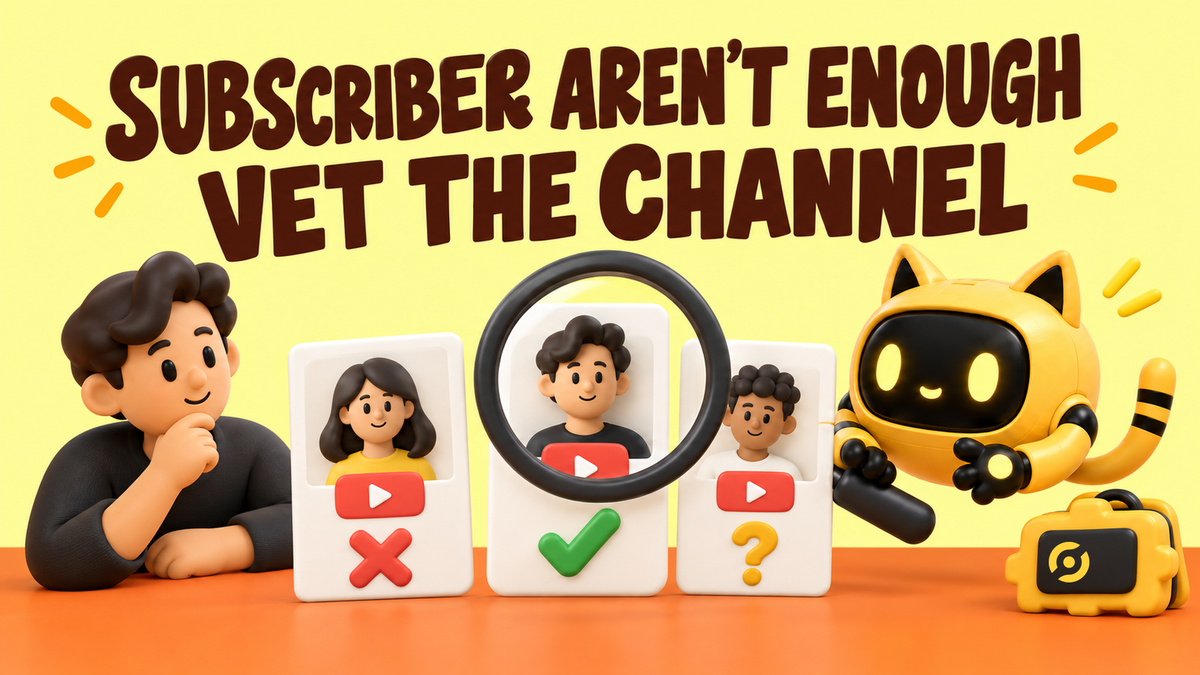
Use two rounds to vet YouTube channels for a product review. First, apply hard filters for market, language, format, recent activity, and category conflicts. Then score the remaining channels on the last ten relevant long-form videos: category fit, review skill, view consistency, purchase-oriented audience questions, commercial transparency, and data that can be verified. Subscriber count is context, not the decision.
For a product such as a home espresso machine, a smaller channel that consistently reviews equipment and attracts detailed setup questions may be more useful than a larger channel that mainly publishes lifestyle Shorts.
Define what this review needs to accomplish
Write a one-page assignment card before looking at channels. Otherwise, a large subscriber count can quietly change the criteria halfway through the shortlist. For a home semi-automatic espresso machine, the card might look like this:
| Item | Example requirement |
|---|---|
| Target audience | U.S. households buying their first semi-automatic espresso machine |
| Primary questions | Setup difficulty, first extraction, and cleaning cost |
| Content format | An 8–12 minute YouTube video, not replaced by Shorts |
| Must demonstrate | Setup, extraction, milk steaming, cleaning, and at least three pros and cons |
| Editorial boundary | The brand can check factual claims; the creator keeps an independent experience and conclusion |
| Commercial terms | Schedule, fee, usage duration, and exclusivity to be confirmed |
Once the assignment is clear, the team can distinguish “not right for this brief” from “not a good channel.” Those are not the same judgment.
OneCrew Creator Discovery helps teams narrow candidates by market, category, audience, and content direction, review public content signals and match reasons, and save candidates into the outreach workflow. Start with the non-negotiable requirements from the assignment card, then keep the source and rejection reason with each candidate so a teammate can continue the review without reopening every channel from scratch.
Round 1: Apply five hard filters
Hard filters answer only one question: can this channel do this assignment? Do not use them as a total score. If a channel fails one, remove it from this review shortlist or consider it for a different format.
- Market and language: The primary content language and available audience evidence fit the target market.
- Content format: The channel still publishes long-form videos and can demonstrate a product in depth.
- Topic relevance: The product category or a closely related use case appears within the last 90–180 days.
- Schedule viability: The channel has not clearly gone inactive, and the likely production window fits the campaign.
- Manageable conflicts: Recent competitor work, exclusivity, or brand-safety concerns do not block the deal.
A channel may have one viral espresso-machine video but spend the next six months on travel vlogs. That may fail the relevance filter. A dedicated home-coffee channel that posts only two long videos each month can still be an excellent match for a detailed review.
Round 2: Score the remaining channels out of 100
Weights should follow the assignment. The example below fits a durable product that needs explanation and demonstration; it is not a universal standard for every campaign.
| Dimension | Weight | Strong evidence | Weak signal |
|---|---|---|---|
| Product and use-case fit | 25 | Recent, repeated coverage of the category, adjacent products, and the target scenario | The category appeared once because it was trending |
| Review and teaching skill | 25 | Shows steps, comparison points, drawbacks, and who the product suits | Unboxing and specification reading only |
| Recent long-form consistency | 15 | Relevant videos have a stable view distribution rather than one isolated spike | Most videos sit far below one viral result |
| Audience purchase intent | 15 | Comments ask about models, maintenance, cost, and practical use | Engagement is mostly emojis or generic praise |
| Commercial transparency | 10 | Sponsorships, gifted products, and affiliate links are disclosed clearly | Commercial relationships are vague and conclusions repeat across brands |
| Data verifiability | 10 | The creator will share the relevant Analytics screenshots, rate, and schedule | Important metrics cannot be defined or confirmed |
Use decision bands instead of pretending the score is perfectly precise: 80 and above is a priority outreach candidate; 65–79 needs more evidence or becomes a backup; below 65 usually stays outside this review shortlist. A failed hard filter overrides the total score.

How do you review the latest 10 videos without being misled by one viral hit?
Separate Shorts, livestream replays, and ordinary long-form videos. For this assignment, record the latest ten relevant long-form videos: publication date, topic, public view count, commercial disclosure, and whether the creator actually used the product. Look at the median and the distribution, not only the average.
Consider a simulated channel with public views of 18k, 21k, 19k, 22k, 20k, 17k, 24k, 19k, 23k, and 210k across its latest ten relevant videos. Once sorted, the middle values are 20k and 21k, so the median is 20.5k. The average is 39.3k. One 210k breakout video nearly doubles the average, which can lead to an unrealistic forecast or price comparison.
Record video age as well. A video that has been live for seven days should not be compared directly with one that has accumulated views for 180 days. Compare performance within the first 30 days where possible, or group videos of a similar age.
How can you tell whether a creator can actually review a product?
A product review is more than placing the product on a desk and reading its specifications. For an espresso machine, watch two or three representative videos and check whether the creator:
- Explains the test conditions, such as beans, grind, warm-up, and settings.
- Shows setup, first use, cleaning, and common failure points.
- Uses a clear comparison point instead of saying one product simply feels “better.”
- Separates product facts, personal preference, and information supplied by the brand.
- Explains who the product suits, who it does not suit, and the learning curve.
- Discloses sponsorships, gifted products, or affiliate relationships in the description.
- Answers practical questions or corrects mistakes in the comments.
Write a review note that another person can verify: “In two machine reviews, the creator demonstrated the full cleaning process and compared similarly priced models; the warm-up time was measured.” Avoid notes such as “high-quality content.”
What do comments reveal about purchase intent?
Comment volume does not equal purchase intent. Sample 30–50 recent comments on relevant videos and classify the questions:
| Comment type | Example | What it tells you |
|---|---|---|
| Model comparison | “How does this compare with the previous model or Brand B?” | The viewer is evaluating options |
| Cost and maintenance | “How often do the filters need replacing?” | The viewer is considering long-term ownership |
| Use-case fit | “Is this enough for a small kitchen and a two-person household?” | The question can map to the target audience |
| Real troubleshooting | “Why is my extraction pressure unstable?” | The content reaches actual users |
| Trust | “Is this sponsored, and is the conclusion independent?” | Disclosure and framing need review |
| Low-information engagement | Emojis, generic praise, and giveaway entries | Do not count these as purchase-intent evidence |
Comments show the concerns of the people who chose to comment, not the entire audience. Use them to judge whether the content triggers product decisions, not to infer the channel’s overall age, location, or income.
Which YouTube metrics are public, and which require creator confirmation?
The YouTube Data API channel resource can expose the channel title, description, uploads, and public statistics such as views, subscribers, and public video count. Subscriber counts may be hidden and may be displayed according to platform rules. Audience geography, age, unique viewers, watch time, retention, and traffic sources are available to the channel owner in YouTube Studio Analytics, with some dimensions subject to privacy thresholds.
| Publicly checkable | Creator-provided or authorized | Do not confuse |
|---|---|---|
| Public videos, titles, dates, and view counts | Audience by geography and age | Content language is not audience location |
| Public or displayed subscriber count and public video count | Watch time, retention, and unique viewers | Subscribers are not recent reach |
| Comments, description disclosures, and public brand history | Historical conversions, fee, schedule, and exclusivity | A third-party estimate is not creator confirmation |
Save the public source and collection date in the OneCrew candidate record, and mark missing information as pending confirmation. Once outreach begins, attach the creator’s reply, Analytics screenshot definition, fee, and schedule to the same record. The team can then distinguish what it observed from what the creator confirmed.
What does a complete simulated evaluation look like?
The following example demonstrates the method. It does not describe real channels, and the scores are not industry benchmarks.
| Candidate | Hard filters | Weighted score | Key evidence | Decision |
|---|---|---|---|---|
| A: equipment review channel | All pass | 86 / 100 | Eight of the latest ten videos are relevant; review steps are complete; many purchase questions | Priority outreach; confirm U.S. audience and schedule |
| B: general lifestyle channel | Fails topic relevance | 74 / 100 | One viral espresso-machine video; most recent content is travel | Exclude from the in-depth review; consider another creative format |
| C: beginner coffee tutorials | All pass | 78 / 100 | Clear tutorials but fewer comparisons; comments focus on beginner questions | Backup candidate for a first-use angle |
The decision is not simply to select the highest number. Candidate A fits an in-depth review, C fits beginner education, and B may suit broader brand exposure but does not meet this assignment. Return to the brief instead of following subscriber count.
Copyable YouTube creator evaluation fields
- Basic information: channel URL, creator name, public business email, other contact routes, and collection date.
- Hard filters: market, language, content format, recent relevance, conflicts, and schedule.
- Latest ten long-form videos: title, date, views, relevance, commercial disclosure, and video age.
- Content evidence: test steps, comparison point, pros and cons, intended user, and correction behavior.
- Comment sample: sample size, purchase questions, maintenance questions, trust concerns, and low-information engagement.
- Public data source: URL, field, and collection date for each observation.
- Data to confirm: geography, age, watch time, retention, rate, schedule, usage rights, and exclusivity.
- Score and decision: dimension scores, hard-filter result, priority / more evidence / reject, and the reason.
How do you request the key data in one outreach email?
Hi [Name], we are looking for YouTube creators who can produce [deliverable] for [product and market]. We reviewed your work on [specific video or topic], especially [specific match point].
If the direction is relevant, could you confirm your availability during [date range]; the fee and what it includes; the primary audience geographies from the last 90 days; an average watch-time or retention screenshot for two or three relevant long-form videos; the brand’s intended content usage; and any category exclusivity?
To keep the definitions consistent, please leave the date range and metric name visible in the screenshots. Sensitive information can be redacted.
Frequently asked questions
How many subscribers should a YouTube creator have before a brand works with them?
There is no universal threshold. Check the hard filters, recent relevant long-form videos, review skill, and audience questions first. Subscriber count is cumulative following, not a measure of stable recent viewing.
Why use the median instead of average views?
The median is less likely to be inflated by one viral video and is useful for describing typical performance. Still review the range, video age, and topic; no single metric replaces content judgment.
Can public videos reveal the audience’s geography?
Language, topics, and comments provide clues. Important geography, age, unique viewers, and watch-time data should come from YouTube Analytics screenshots supplied by the creator or an authorized tool.
Can third-party audience estimates be used?
They can support early screening if you save the source, collection date, and an “estimate” label. Before pricing and contracting, ask the creator to confirm the data that affects the decision.
Make every “good fit” reviewable by someone else
Use hard filters to remove channels that cannot meet the brief, then compare the remaining candidates with a weighted score. Label every public source and ask creators to confirm private metrics. OneCrew can narrow the candidate set from the assignment criteria, keep the content evidence and rejection reasons, and connect outreach replies and missing data to the same record. The final handoff should be a set of explainable decisions, not a list of channel names.