How to Structure a Paid Creator Pilot Before a Retainer
Define one objective, a paid scope, revisions and usage before a creator pilot. Includes an invitation template and separate acceptance and continuation records.

You want to test a creator before committing to a monthly arrangement. The creator does not want to spend several days producing work for free. Before anyone films, the conversation has become an argument about trust. A clearly scoped, paid pilot gives both sides something concrete to evaluate. Agree on what you want to learn, what will be delivered, what it costs and when you will decide on the next step.
In one creator's account, a brand proposed a five-day unpaid trial before considering a retainer. The work included setting up social accounts, preparing them, posting and waiting for results. That is a useful starting point for a different question: how can a brand offer a small paid project with a clear beginning and end?
Choose one thing the pilot should establish
Are you testing whether the creator can explain the product naturally, or how the content performs on a particular channel? A short demonstration can help answer the first question. The second also depends on the publishing account, audience, distribution budget and observation period. Mixing them can turn a production assessment into a dispute about why a compliant video did not generate sales.
Write a specific objective before sending the invitation. For example: “Show how someone takes a laptop out of the backpack, and explain the size accurately.” This is an illustrative objective, not an industry standard. Review relevant existing work first, then invite shortlisted creators to any test that requires new production.
OneCrew helps teams organize creator information, email communication and working records. Save the relevant portfolio links, reasons for shortlisting and remaining questions in one table. When you prepare the invitation, you can explain what caught your attention and what this particular pilot needs to establish.
Put six decisions in the offer
- Deliverables: number of videos, length range, aspect ratio and captions; say whether posting is included.
- Work: who writes, films and edits, and whether any raw clips are included.
- Payment: fee, currency, payment milestones and any agreed paperwork.
- Revisions: included rounds, corrections and how new scenes or reshoots will be agreed.
- Usage: internal evaluation, organic publishing or paid advertising, with the actual scope specified.
- Decision dates: who reviews the work, when feedback arrives and when a longer arrangement will be discussed.
If you need account creation and ongoing publishing, list those as work in their own right, including account ownership and access arrangements. They should not disappear inside the phrase “one test video.” Similarly, do not leave the agreed production fee dependent on an undefined views or sales threshold.
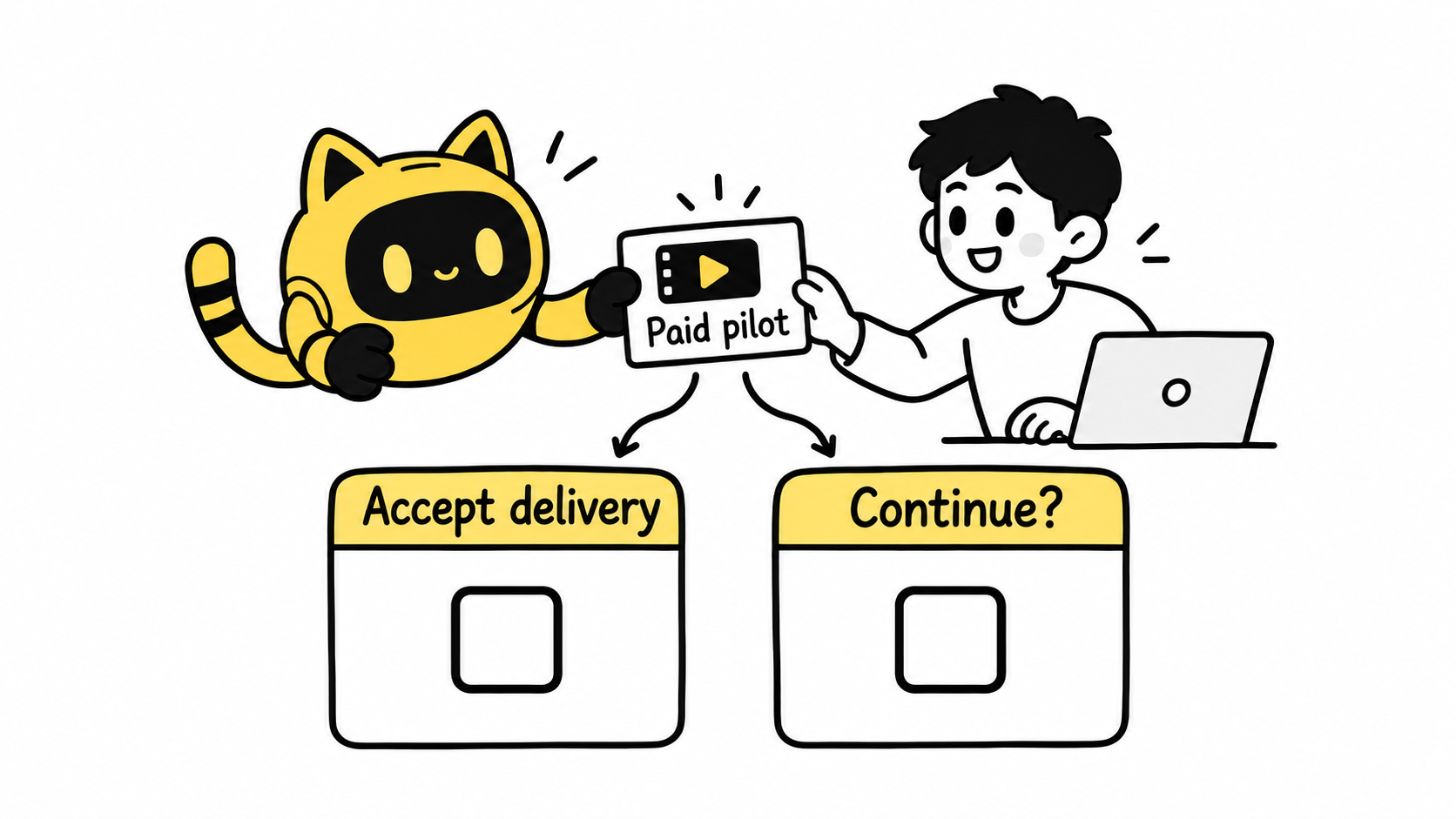
Keep the current job separate from the future opportunity
Adapt this invitation using confirmed information. Resolve internal blanks before presenting them as an offer.
Subject: Paid pilot for [product] — [specific deliverable]
Hi [name], we liked [specific detail] in [portfolio link]. We would like to commission a paid pilot for [product], focused on [one clear objective].
The deliverable is [quantity, length, format and scope], for [fee and currency], payable at [agreed milestones]. It includes [revision scope], with the content used for [agreed purpose]. We propose delivery by [date and time zone], with feedback from [reviewer] by [date].
After the pilot, we would like to discuss a longer partnership on [date]. Any ongoing volume and fees would be agreed separately; that discussion does not change the terms of this pilot. Please let us know your availability and any changes you would suggest.
Save the invitation as an email draft in OneCrew. Check the recipient, portfolio reference and terms before sending. If the creator proposes a different date or fee, update the record once the revised terms are agreed and retain the location of that reply. The working table should reflect the conversation's current position.
Record acceptance and continuation as separate decisions
Review the delivery against the brief: did it show the agreed action, describe the product accurately and meet the file requirements? Request corrections by pointing to a specific moment and requirement. If the brand changes direction after seeing the video, discuss that new work separately.
Then evaluate whether the relationship should continue. Consider communication, the creator's delivery style and whether their process suits the proposed frequency. If you assess performance, record the channel, time window and any paid distribution. One video's result does not establish repeatable long-term performance.
In OneCrew, keep delivery results, revision confirmation, payment progress and the next-stage decision separate. A single “approved” label should not have to mean that the content was accepted, the invoice was paid and a retainer was signed.
When both sides are ready to expand, review how to propose a monthly creator partnership. For now, choose one shortlisted creator and record the single question your pilot should answer in OneCrew. Build the invitation around that question.