High Engagement Does Not Equal Buying Intent: How to Select Creators Who May Convert
Use content evidence, decision-oriented comments, and creator-confirmed data to screen creators instead of treating engagement rate as a sales forecast.

Short answer: engagement rate measures visible attention, not purchase intent. Use it to remove obvious mismatches, then inspect recent category content, decision-oriented questions in comments, commercial transparency, and creator-confirmed audience or campaign data. Keep public facts, team judgment, and private confirmation in separate fields.
The underlying concern came from a self-described creator manager who argued that brands can see likes and follower counts but not the intent behind them. That community discussion is a useful prompt, not a universal benchmark. The process below reduces uncertainty; it does not claim that public signals can predict sales.
Why engagement and buying intent are different
A like can mean affection for the creator, agreement with an opinion, participation in a giveaway, or simple entertainment. A purchase requires product understanding, trust in the use case, price acceptance, and an action. Engagement rate compresses those motives into one ratio. It tells you that content caused a reaction, not what the reaction will become.
- Attention: views, likes, emoji, and generic praise.
- Consideration: questions about fit, size, use case, alternatives, or limitations.
- Action: questions about where to buy, stock, shipping, or offer terms—and, where attribution is reliable, creator-confirmed click or sales data.
A question about where to buy is expressed interest, not a completed purchase; a click is not an order either. Verify the source, time window, refunds, and attribution rules before recording sales.
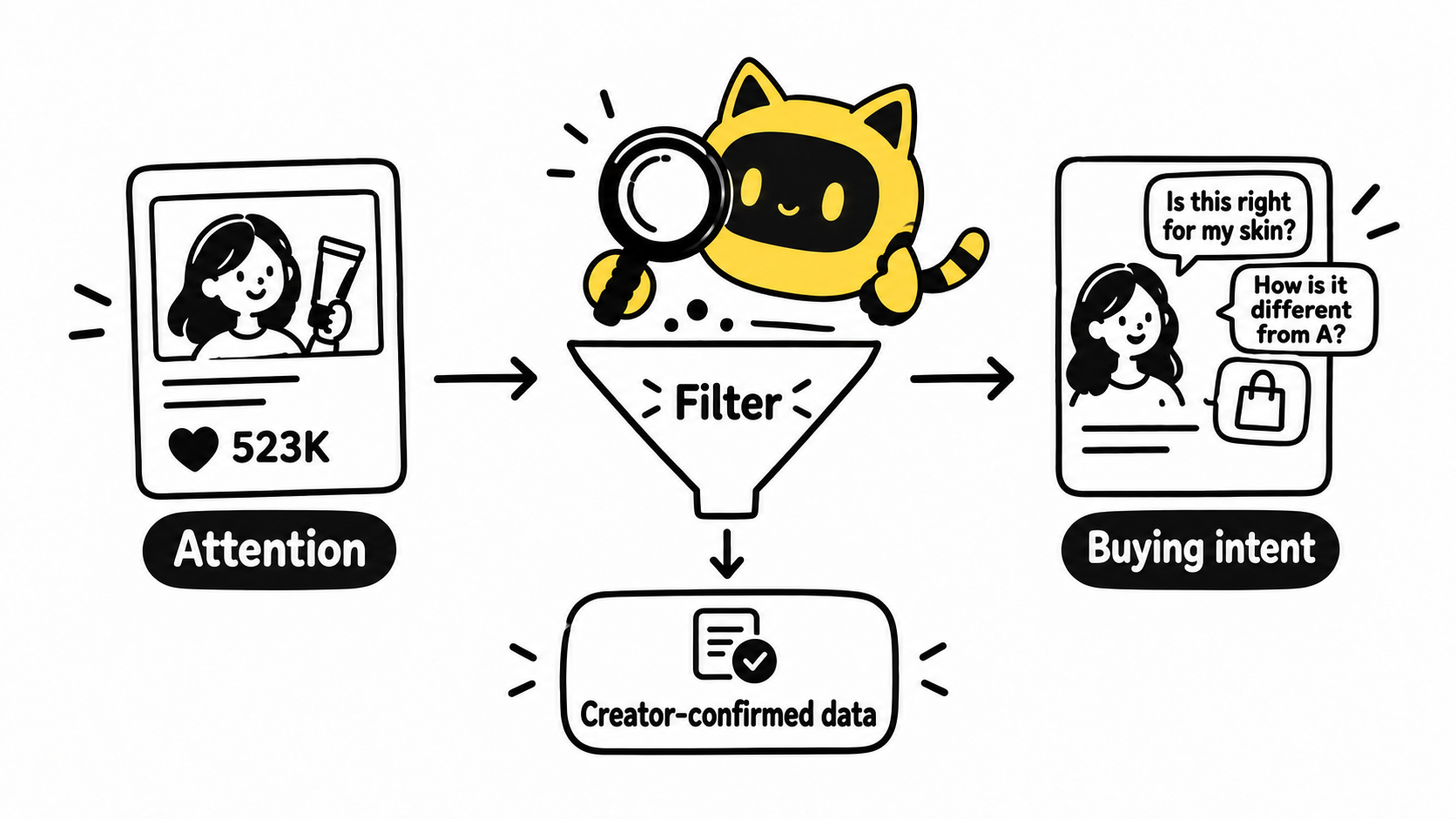
OneCrew connects AI with creator discovery, email workflows, and dynamic tables. Give the AI the content links and comment samples you have checked, ask it to separate attention, comparison, and purchase questions, then save the observations in a OneCrew table with the fields this project needs. Keep the original comments and links so teammates can review the classification.
Define the action before you rank creators
Write one observable action: understand a new category, compare two approaches, visit a product page, request a trial, or buy. “Build awareness” is too broad to determine which creator evidence matters. For a new technical product, explanation skill and qualified questions may matter more than immediate sales. For a familiar standard item, verified historical clicks or affiliate performance may deserve more weight.
Working hypothesis: for UK consumers with sensitive skin, test a 30–60 second product-in-use explanation that answers irritation and comparison questions; observe qualified questions and product-page visits, and count sales only where attribution is reliable.
A four-step creator selection process
1. Review the latest 10–20 posts, not the profile impression
As a starting point, review 10–20 relevant posts from roughly the last 90 days, adjusting for the channel’s publishing frequency. These are suggested sampling choices, not platform standards. Record topics, formats, hands-on use, limitations, replies, and exact source links. OneCrew lets a connected AI discover YouTube creators by searching public video information around a content topic and save candidates, channel links, and evidence-based match evaluations in dynamic tables. Review the returned videos before judging fit for this assignment.
2. Sample comments on comparable category posts
Choose two or three relevant posts per creator. Sample top comments, recent comments, and creator replies. Classify them as generic engagement, use question, comparison question, purchase question, or post-purchase issue. Use the same sampling rule across candidates so the team does not cherry-pick comments that support a favorite.
3. Check commercial transparency
Look for clear disclosure, realistic limitations, and brand conflicts. In the United States, payment, free products, and other material connections require clear, hard-to-miss disclosure. The FTC's official endorsement guidance also makes clear that disclosure responsibility cannot be outsourced entirely to a platform feature. Compliance does not prove conversion, but it is a basic threshold for a durable partnership.
4. Ask finalists only for decision-critical private data
Request audience geography, relevant age ranges, retention, or available click data for comparable recent content, with a stated time window. Do not demand an entire media kit if one screenshot answers the next decision. Historical conversions, fees, availability, and rights must be confirmed by the creator or a reliable brand record.
Once you know what is missing, save a focused email draft in OneCrew specifying the metric, content scope, and time window. Preview it and confirm the recipient and wording before sending. When a reply arrives, check the attachment’s definitions and update the table’s confirmation status.
For a focused request and clear data definitions, see what to ask creators for before a partnership.
Separate evidence into three layers before making a decision
| Evidence layer | What it can answer | What it cannot prove |
|---|---|---|
| Public fact | Content topic, date, visible comments, and public contact route | Historical conversion, buying power, availability, or fee |
| Team judgment | Why the creator fits this market, product, and assignment | It is not platform data or a creator commitment |
| Creator-confirmed fact | Private audience data, commercial terms, timing, and rights | Contracts, finance, and formal approvals still need their own systems |
Separate public observations, team judgments, and creator-confirmed details so another teammate can review the decision. Keep the source and date. If evidence is missing, state what needs confirmation rather than turning an unknown into a mismatch.
A practical 100-point creator scorecard
| Dimension | Points | Evidence |
|---|---|---|
| Assignment and content fit | 30 | Recent, repeated coverage of the required use case |
| Decision-question quality | 20 | Fit, comparison, price, and purchase questions in sampled comments |
| Explanation and response skill | 15 | Handles limitations and follow-up questions without exaggeration |
| Audience evidence | 15 | Creator-confirmed geography and audience match |
| Commercial transparency | 10 | Disclosure, brand conflicts, and partnership history |
| Execution feasibility | 10 | Fee, schedule, deliverables, and rights |
This 100-point table is an adjustable human assessment example, not a validated sales model or OneCrew’s official score. Cap each dimension at its listed weight, totaling 100. Mark essential missing evidence “to confirm” and request it; do not score unknowns as zero and rank them against complete records. Confirm essential requirements such as market, format, availability, and usage scope first. Pause a confirmed conflict rather than letting unrelated strengths offset it.
Validate with a small, comparable test
- Choose two or three creators from five to eight evidence-backed finalists.
- Hold product, market, observation window, and primary action constant.
- Confirm links, disclosure, offer rules, and attribution before publication.
- Record context as well as outcomes: question types, visits, confusion, returns, and usable learning.
- Classify each result as continue, revise and retest, or pause, with a written reason.
In OneCrew, define the table fields this project needs: reviewed video links, comment observations, confirmation status, owner, and next action. Ask the AI to develop a fit rationale from that evidence and update the same record when new information arrives. Compare actual trial results with the original hypothesis, then record why you will continue, adjust, or pause so the next review has a clear starting point.
Frequently asked questions
Is engagement rate useless?
No. It can flag anomalies and compare similar posts from the same creator. It is a first-pass signal, not a standalone measure of buying intent.
What percentage of purchase questions is good?
There is no universal threshold. Fix the sampling method and content type first. If the sample is small, label the evidence insufficient instead of manufacturing precision.
What if a new brand has no conversion history?
Use content fit and question quality to form a small test. The first campaign should reduce uncertainty, not prove that a creator is guaranteed to sell.
Can third-party audience estimates replace creator analytics?
No. Estimates help with screening. Label the source, ask finalists to confirm decision-critical private data, and evaluate later campaigns with the brand's own reliable results.
Start with one creator today
Take the creator with the highest engagement rate on your current list and ignore the score. Review three recent category posts and 20 comments on each. Separate public facts, your judgment, and what the creator must confirm. Then save the exact evidence, fit reason, and next question in OneCrew before comparing the next candidate.