Should a U.S. DTC Brand Test CTV Ads When Traffic Plateaus?
A practical framework for deciding whether a U.S. DTC brand should test CTV, including objectives, budget, frequency, measurement, and stop rules.

Slower growth from paid search and social does not automatically mean the next budget should go to connected TV. CTV is television inventory delivered through an internet-connected TV or a connected streaming device. It can add a new viewing environment, but a useful test still depends on the objective, creative, measurement access, and the amount the brand can afford to learn with.
The decision question is not “Does CTV work?” It is: after this test, will you be able to tell whether CTV added reach, changed brand demand, or produced incremental conversions?
Make sure the current channels are actually saturated
Put several comparable periods of search and social performance side by side: spend, target-audience reach, frequency, new-customer cost, landing-page conversion, and contribution margin. Creative fatigue, a slower site, inventory issues, or tighter audience settings can look like channel saturation. Start with this ad-clicks-without-sales diagnostic if the existing funnel has not been checked yet.
CTV becomes a reasonable test when the existing funnel is measurable and stable, and the brand has a specific need for incremental reach. It should not be the next platform simply because it is the only one left on the list.
Give the first test one primary question
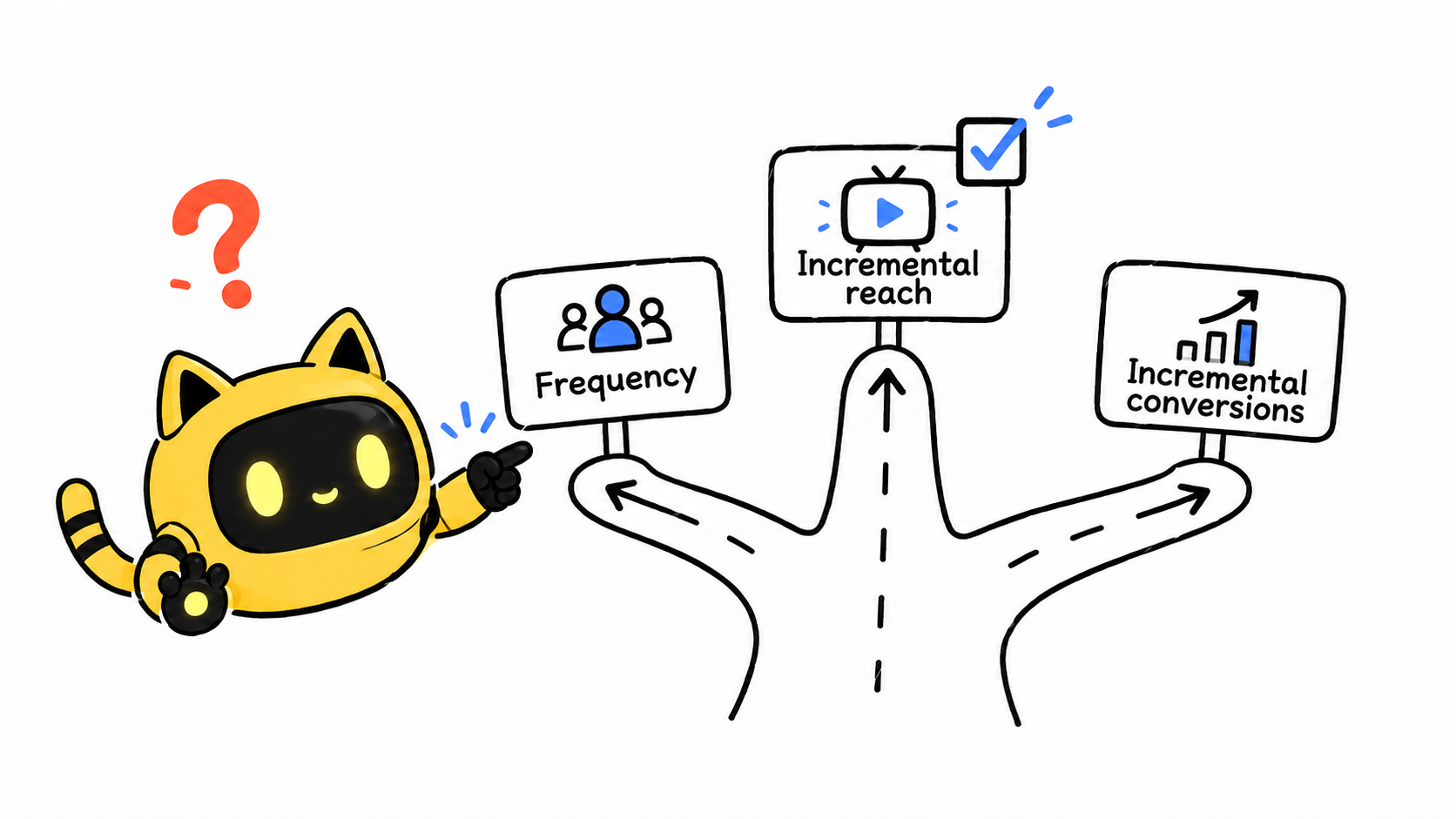
A first test might ask whether CTV reaches people your current media misses, lifts branded demand or direct visits, or produces incremental conversions. You can observe all three, but choose one as the decision metric before launch.
According to Google Ads’ current documentation, cross-media reporting centers on deduplicated reach and frequency and accounts for co-viewing on connected TVs. For campaigns designed to drive sales, leads, or site traffic, Google points advertisers toward conversion lift measurement. Some reports and experiments require account eligibility, sufficient volume, or representative access, so verify those conditions before committing the budget.
Complete a one-page test brief before buying media
- Market: Define the country, regions, and exclusions.
- Audience: Use executable criteria rather than a label such as “affluent shoppers.”
- Primary objective: Incremental reach, brand impact, or incremental conversion.
- Baseline: Record branded search, direct traffic, conversions, and media spend for the same market.
- Creative: Prepare multiple versions that meet the chosen inventory’s current specifications.
- Response path: Make the QR code, short URL, or cross-device journey usable from a TV screen.
- Frequency: Set a monitorable target or cap.
- Stop rule: Define when to pause, extend, or scale the test.
Work backward from the cost of a decision
Do not copy another advertiser’s test budget. Ask the platform or partner for expected CPM, addressable reach, minimum commitment, geographic granularity, frequency controls, attribution windows, and measurement access. Then calculate the spend required for a test long enough to answer the primary question. Creative production and measurement are part of the test cost too.
If the available budget buys too little reach, or the account cannot meet an incrementality study’s requirements, narrow the objective. Treat the first flight as creative and audience learning instead of declaring CTV effective or ineffective from underpowered data.
Eight questions for a CTV platform or partner
- Which apps, channels, and device environments supply the inventory?
- Can the campaign reach the intended market and audience?
- How are frequency and frequency distribution controlled?
- How is co-viewing included in reach?
- Which brand and conversion studies are available to this account?
- Are there minimum spend, impression, or managed-service requirements?
- What are the creative specifications, review times, and replacement rules?
- Can the reporting dimensions be exported and reconciled with site data?
Separate ad delivery from incremental business
Reach, frequency, completed views, and branded-search movement can show that the media delivered and generated attention. They do not, on their own, prove that CTV caused additional sales. Use a controlled conversion lift study when the account qualifies. Otherwise, define a geographic or time-based comparison in advance and describe the result as directional.
A useful readout has three layers: did the campaign deliver as planned, did it reach the intended audience, and did business performance move beyond the baseline? State the source and limitations of each layer.
When to postpone the test
Postpone CTV if checkout is visibly broken, conversion tracking is unstable, the brand lacks TV-ready creative, contribution margin cannot absorb the learning period, or the team can only evaluate last-click revenue. If channel fit is still unclear, use this ecommerce acquisition-channel framework first. CTV is most useful as a media experiment with a hypothesis, baseline, and stop rule—not as an emergency exit from paid-social fatigue.